



Sep.22,2026
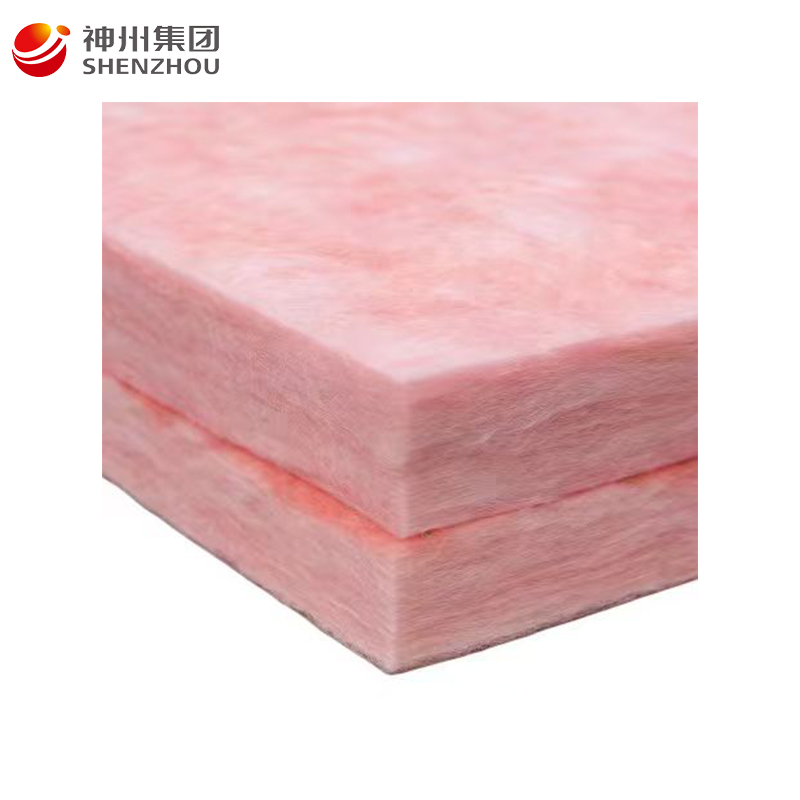
Insulation density should be selected according to the required thermal, acoustic, mechanical and installation performance, rather than simply choosing the highest or lowest value. For example, Shenzhou lists glass wool at approximately 10–48 kg/m³, while its rock wool boards range from 60–200 kg/m³; these differences affect rigidity, handling and application suitability, but density alone does not determine overall insulation performance.
Density represents the mass of insulation material contained within a given volume. For procurement teams, it is useful because it can influence several practical properties, including rigidity, handling, acoustic behavior and suitability for particular construction systems.
However, density should not be treated as a simple “higher is better” specification.
A high-density product may provide greater rigidity or mass, while a lower-density product may be easier to handle and install. The correct choice depends on the application and the other specifications required by the project.
A useful procurement specification should include:
| Parameter | Why buyers should check it |
|---|---|
| Density | Helps identify the physical grade |
| Thermal conductivity | Indicates thermal insulation performance |
| Thickness | Determines the installed insulation layer |
| Fire classification | Determines suitability for fire-sensitive applications |
| Moisture resistance | Important for humid environments |
| Mechanical strength | Important for loaded or rigid assemblies |
| Product format | Affects installation method |
| Operating temperature | Limits application range |
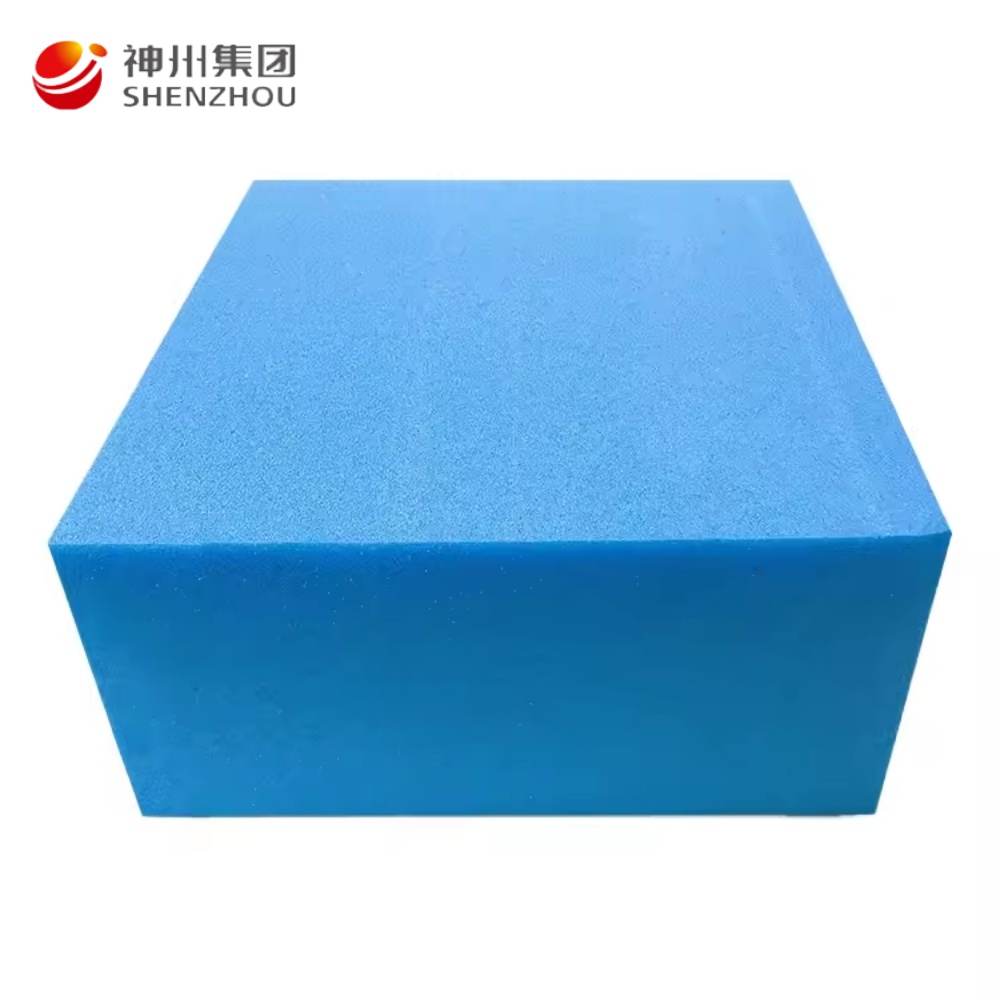
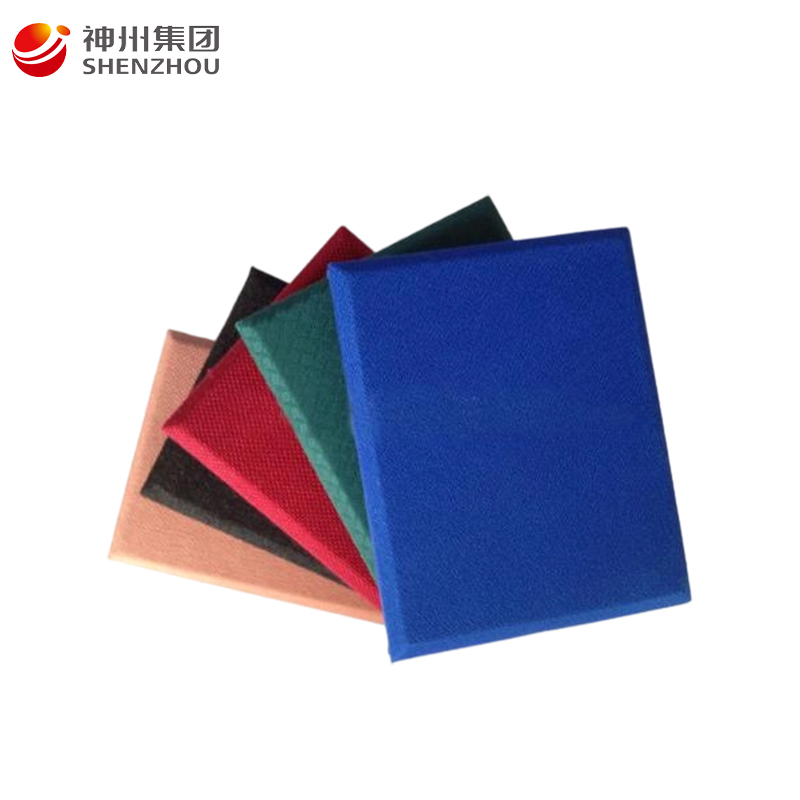
Shenzhou's current portfolio includes glass wool, rock wool, rubber foam, ceramic wool, XPS boards, acoustic panels and aerogel insulation, so the density requirement should be considered together with the material category rather than independently.
No. Thermal conductivity and density are related, but they should not be treated as interchangeable specifications.
For example, Shenzhou's published glass wool specifications give a thermal conductivity range of 0.033–0.044 W/(m·K) across products with densities of approximately 10–48 kg/m³. This demonstrates why a buyer should request the actual thermal conductivity of the selected grade instead of selecting purely by density.
For a project requiring a specific thermal resistance, the procurement team should therefore compare:
Density + thermal conductivity + thickness
rather than:
Density alone
The same material category can be supplied in different thicknesses.
Shenzhou's published glass wool information lists common thicknesses of 25–100 mm and beyond, depending on the required thermal performance.
For example, if a project specification requires a particular thermal resistance, changing the density without checking thickness and thermal conductivity may result in an unsuitable design.
Higher-density products can be useful where the insulation needs greater rigidity, structural stability or specific acoustic performance.
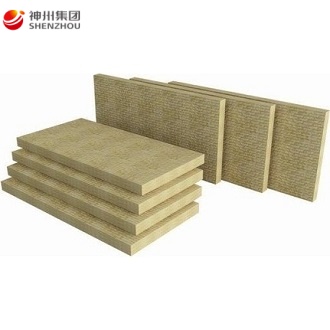
For example, Shenzhou lists rock wool board densities of 60–200 kg/m³, while rock wool blankets are listed at 40–80 kg/m³ and rock wool pipe sections at 80–150 kg/m³.
These different ranges reflect different product formats and applications.
| Product format | Shenzhou-published density range | Typical application direction |
|---|---|---|
| Rock wool board | 60–200 kg/m³ | Facades, roofs, partitions, industrial casing |
| Rock wool blanket | 40–80 kg/m³ | Ducts, tanks, vessels, cavities |
| Rock wool pipe section | 80–150 kg/m³ | Steam and process piping |
The important procurement lesson is that density should be matched to product format and installation conditions.
It can, but density should not be considered independently from thickness, structure and the acoustic objective.
There is an important difference between:
Shenzhou's published rock wool information gives an NRC range of 0.7–1.0, depending on density and thickness. It also notes that lower-density rock wool in the 40–60 kg/m³ range can be used for sound absorption, while higher-density products can contribute to sound insulation through increased mass.
Therefore, an acoustic procurement specification should state the intended performance rather than simply asking for “high-density insulation.”
Lower-density insulation may be useful when weight, flexibility and installation speed are important.
Shenzhou's glass wool specifications cover approximately 10–48 kg/m³, and the company describes glass wool as a lightweight material used in walls, roofs, HVAC systems and industrial applications.
Potential advantages include:
The limitation is that a lightweight material may not provide the same rigidity or mechanical resistance as a denser board.
The failure may not immediately appear as a product defect. Instead, the insulation system may fail to meet the project's intended requirements.
Possible problems include:
For example, specifying a flexible low-density product where a rigid board is required can create installation problems even if the material's thermal conductivity appears acceptable.
The two materials should not be compared using density alone.
Shenzhou lists glass wool at approximately 10–48 kg/m³, while rock wool boards can reach 200 kg/m³. Rock wool blankets, however, are listed at 40–80 kg/m³, showing that product format itself has a major influence on the available density range.
| Procurement requirement | Parameter to prioritize |
|---|---|
| Lightweight wall insulation | Density + thermal conductivity |
| Rigid board application | Density + compressive/mechanical properties |
| HVAC duct insulation | Format + density + thermal conductivity |
| Acoustic treatment | Density + thickness + acoustic rating |
| Fire-sensitive application | Fire classification |
| High-temperature industrial use | Service temperature + material type |
This approach avoids treating one specification as a substitute for the complete performance requirement.
A useful insulation RFQ should specify:
Shenzhou currently operates 12 factories and states that it has 40+ years of industry production experience and 100+ certifications and global standards, while its portfolio covers several insulation categories. These capabilities can be relevant when a project requires different insulation materials from the same supplier.
No. Higher density can be useful for rigidity or specific acoustic applications, but thermal conductivity, thickness, fire performance and installation requirements must also be considered. The appropriate density depends on the complete system specification.
Shenzhou's published glass wool information gives a density range of approximately 10–48 kg/m³. The appropriate grade depends on the application and required thermal, acoustic and mechanical performance.
There is no single suitable density for every application. Shenzhou lists rock wool board densities of 60–200 kg/m³, blankets at 40–80 kg/m³, and pipe sections at 80–150 kg/m³, so the product format and application should be specified first.
Yes, but density is only one factor. Thickness, material structure and the acoustic design of the assembly also influence the final result; Shenzhou's rock wool data, for example, gives an NRC range of 0.7–1.0 depending on density and thickness.
Provide the application, required material, thickness, density if specified, thermal requirements, fire requirements, quantity and product format. You can contact Shenzhou at qiu@shenzhoujt.cn for project-specific product selection and quotation.
Density is an important insulation specification, but it should never be used as the only selection criterion. For procurement, compare density, thermal conductivity, thickness, fire performance, mechanical requirements and product format against the actual application.
Shenzhou's range illustrates this clearly: glass wool is published at approximately 10–48 kg/m³, while different rock wool formats cover substantially different density ranges. The correct choice therefore depends on what the insulation system needs to achieve, not simply on selecting the highest density.
Contact Shenzhou: qiu@shenzhoujt.cn
Website: www.shenzhougroup.com.cn