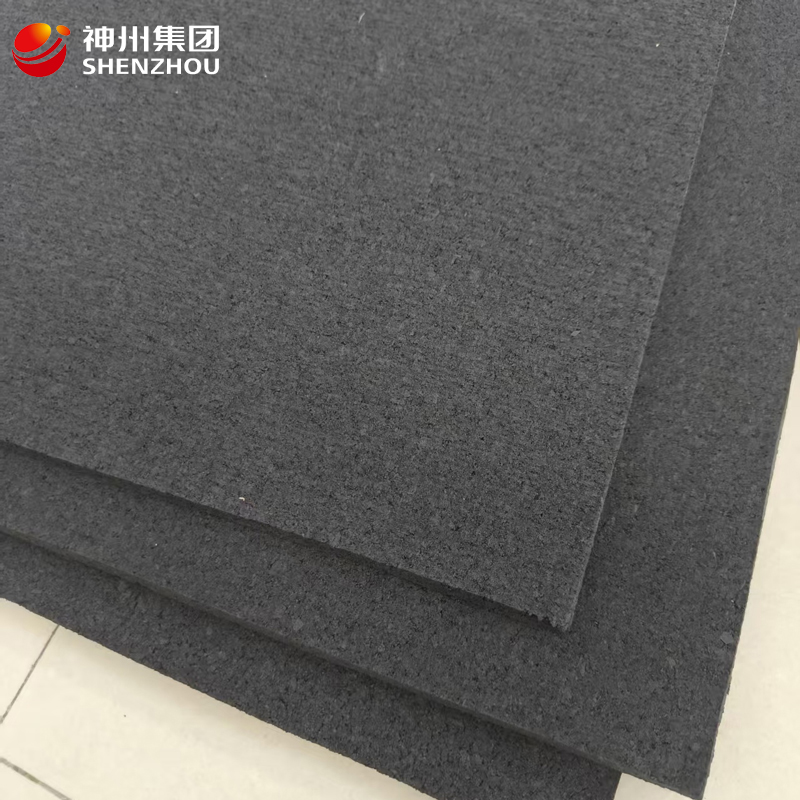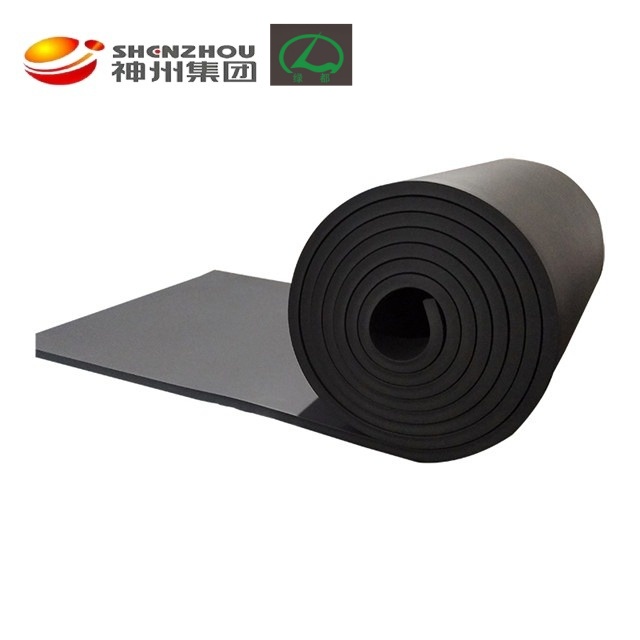




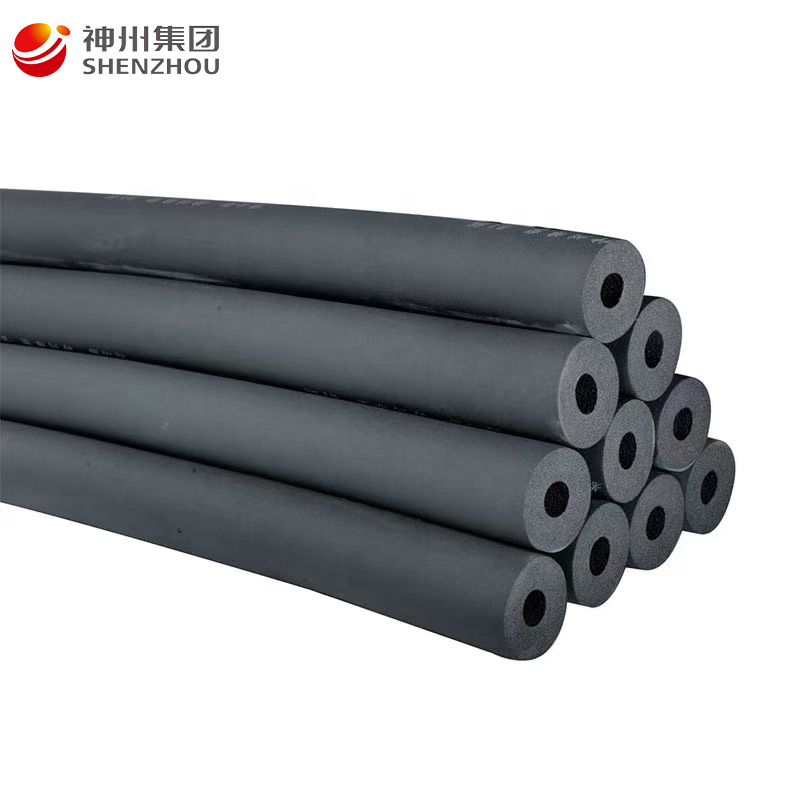
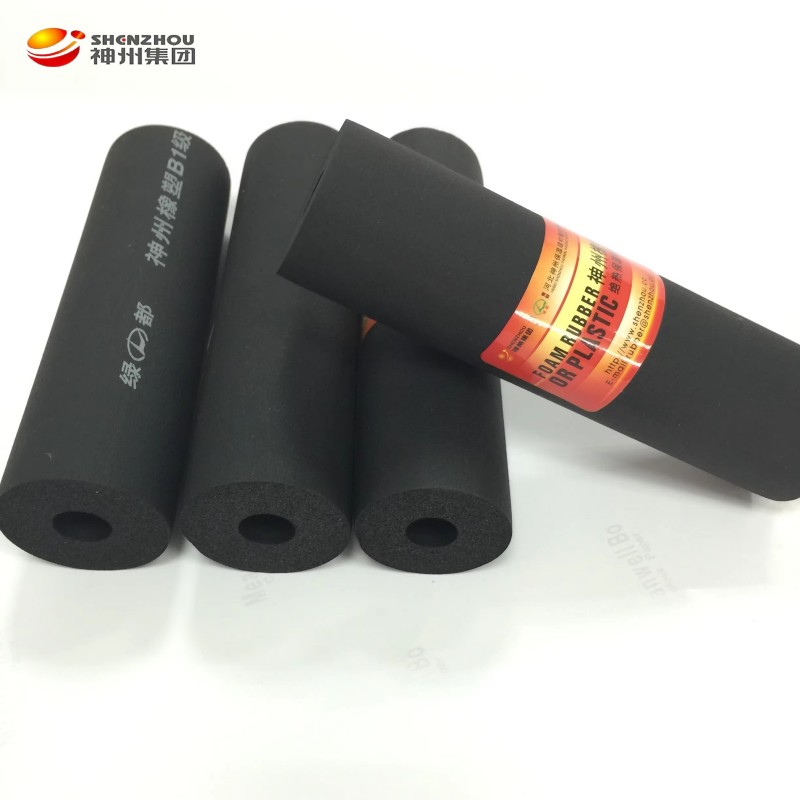
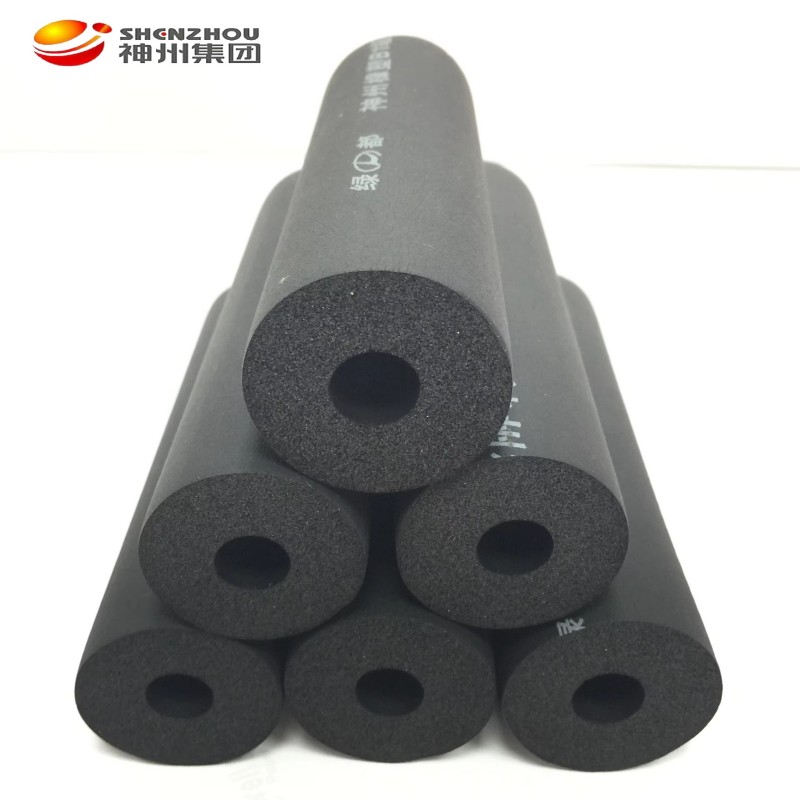


Shenzhou Class O/Class 1 Rubber Pipe Insulation is a kind of flexible insulation material with completely closed cell, whichis mainly made of nitrile but a diene rubber. The product has excellent thermal performance. Foam Rubber Insulation Pipes are widely used invarious public places, industrial plants,clean rooms,medical scenes, education scenes and others cenes.
Closed Cell Rubber Pipe Insulation is a flexible, lightweight elastomeric thermal insulation material designed for insulating chilled water lines, heating pipes, ductwork, tanks, and vessels. Its expanded closed-cell structure forms an effective vapor barrier that prevents condensation (“sweating”) on cold pipelines and helps avoid frost formation in refrigeration and chilled water systems. At the same time, it efficiently reduces heat loss in hot piping systems.
Thanks to its dense surface layer and closed-cell structure, the material maintains stable thermal conductivity during long-term service. Rubber Insulation for Pipes provides a fast, efficient, and reliable solution for pipe insulation in HVAC, plumbing, hot water heating, air conditioning, and refrigeration systems. It is highly flexible and easy to install on both pipes and tubing.
In addition to thermal performance, the Rubber Insulation for Pipes also helps protect pipes against corrosion and acts as a vibration dampener. A light talcum powder coating on the inner surface supports easier installation and faster pre-assembly in production or on-site applications.
Closed cell rubber foam pipe insulation provides a quick and efficient method for insulating refrigeration, cooling, and heating pipelines. Installation should be carried out on dry, clean, and unheated pipes.
Two main installation methods are commonly used:
The tubing can be easily cut and shaped for fittings such as elbows, tees, and bends. For threaded fittings, sleeve covers should be made using insulation of the same thickness as the pipe, ensuring proper overlap with the existing insulation layer.
It is important not to compress the rubber foam insulation material, as this may reduce its thermal performance and lead to condensation risks. Always select the correct size, avoid stretching, and ensure full coverage without tension. All seams and joints should be properly sealed to maintain insulation integrity.
Key Properties of Rubber Pipe Insulation
· Low thermal conductivity (low K-value), ensuring high insulation efficiency for heating and cooling systems
· Suitable temperature range: -40°C to 105°C
· Free from CFC, asbestos, chlorine, and fibers; safe and non-allergenic to skin
· Chemically inert and compatible with most pipe metals
· High mechanical strength; resistant to tearing, impact, and rough handling
· Maintains performance under harsh site conditions
· At -25°C, the material becomes harder, but thermal performance and vapor resistance remain unaffected
· With increasing temperature up to 105°C, it maintains stable insulation performance
· Smooth surface provides a clean and aesthetic finish; no additional coating required for most indoor applications
· Excellent resistance to ozone and ultraviolet (UV) exposure
Tube Specifications and Models Table
|
Suitable for Tube Sizes |
Inside Diameter |
Insulation Wall Thickness(mm) |
|||||||||
|
(in) Outer Diameter of Copper Pipe |
(DN) Galvanized Pipe Nominal |
(mm) Seamless Pipe Outside Diameter |
(mm) Rubber Foam Inside Diameter |
9 | 15 | 20 | 25 | 32 | 40 | 50 | |
|
1/4 " |
— — |
— — |
6 |
6X9 10X9 13X9 16X9 19X9 22X9 25X9 27X9 32X9 34X9 38X9 43X9 48X9 57X9 60X9 |
6X15 10X15 13X15 16X15 19X15 22X15 25X15 27X15 32X15 34X15 38X15 43X15 48X15 57X15 60X15 76X15 89X15 108X15 |
6X20 10X20 13X20 16X20 19X20 22X20 25X20 27X20 32X20 34X20 38X20 43X20 48X20 57X20 60X20 76X20 89X20 108X20 |
13X25 16X25 19X25 22X25 25X25 27X25 32X25 34X25 38X25 43X25 48X25 57X25 60X25 76X25 89X25 108X25 |
16X32 19X32 22X30 25X32 27X32 32X32 34X32 38X32 43X32 48X32 57X30 60X30 76X30 89X30 108X30 |
25X40 27X40 32X40 34X40 38X40 43X40 48X40 57X30 60X30 76X30 89X30 108X30 |
25X50 27X50 32X50 34X50 38X50 43X50 48X50 57X30 60X30 76X30 89X30 108X30 |
|
|
3/8 " |
6 |
— — |
10 |
||||||||
|
1/2 " |
— — |
— — |
13 |
||||||||
|
5/8 " |
8 |
14 |
16 |
||||||||
|
3/4 " |
— — |
— — |
19 |
||||||||
|
7/8 " |
15 |
22 |
22 |
||||||||
|
1 " |
— — |
25 |
25 |
||||||||
|
1-1/8 " |
20 |
28 |
28 |
||||||||
|
1-1/4 " |
— — |
32 |
32 |
||||||||
|
— — |
— — |
— — |
34 |
||||||||
|
1-1/2 " |
|
38 |
38 |
||||||||
|
1-5/8 " |
32 |
— — |
43 |
||||||||
|
1-7/8 " |
40 |
— — |
48 |
||||||||
|
2-1/4 " |
— — |
57 |
57 |
||||||||
|
2-3/8 " |
50 |
— — |
60 |
||||||||
|
— — |
70 |
76 |
76 |
||||||||
|
— — |
80 |
89 |
89 |
||||||||
|
— — |
|
108 |
108 |
||||||||
Sheet Specifications and Models Table
|
Test Items |
Length(m) |
Width(m) |
Area(m2) |
|
10mm |
20 |
1 |
20 |
|
15mm |
10 |
1.2 |
12 |
|
8 |
1.5 |
||
|
20mm |
10 |
1.2 |
|
|
8 |
1.5 |
||
|
25mm |
10 |
1.2 |
|
|
8 |
1.5 |
||
|
30mm |
10 |
1.2 |
|
|
8 |
1.5 |
Note:
1. Pipe length is 2m, diameter is larger than 100mm, rubber foam sheet will be adviced.
2. Double-layer or multi-layer installation is recommended when the insulation layer is larger than 50mm.
3. The above specifications are commonly used specifications, products for black , such as special specifications and colors, to communicate with the sales staff to
customize.
4. The materials should be stored in a clean and dry place in a normal room with a relative humidity of 50-70% and an ambient temperature of 0-35 °C.
Technical Data Sheet
|
Test Items |
Performance Indicators |
Compliance Standards |
|||
|
Density |
≤95 kg/m3 |
GB/T 6343-2009 |
|||
|
Service Temperature |
-40℃ to 105℃ |
|
|||
|
Thermal Conductivity |
Average Temp. |
-20℃ |
0℃ |
+25℃ |
GB/T 10294-2008 ASTM C518 ASTM C177 |
|
W/m.K |
0.032 |
0.034 |
0.036 |
||
|
Water Vapour Permeability |
< 4.0 x 10⁻¹¹g/(m.s.Pa) u ≥4500 |
GB/T 17146-2015 |
|||
|
Water Absorption by Volume |
≤0.50% |
GB/T 17794-2021 |
|||
|
Reaction to Fire |
B1 grade(C-s3,d0,t1) |
GB 8624-2012 |
|||
|
Class 1 |
BS 476-7 |
||||
|
V-0,sVA/ HF-1,Self Extinguishing,Does not Drip |
UL94 |
||||
|
Oxygen Index |
≥32 |
GB/T 2406-2008 |
|||
|
Smoke Density Class |
≤75 |
GB/T 8627-2007 |
|||
|
Compression Rebound Rate |
≥ 70% |
GB/T 6669-2001 |
|||
|
Dimension Stability |
≤10.0% |
GB/T 8811-2008 |
|||
|
Aging Resistance |
Slightly Crumpling, No cracks, No pin holes, Not deforming |
GB/T 16259-2008 |
|||
|
Ozone Resistance Corrosion Resistance Environment |
Good No Corrosion Dust and Fibre Free CFC Free, Tero ODP, Zero GWP |
|
|||
What industries use rubber insulation for pipes?
Related Products